What it is
A Five Corner Triangle is the most recent of my modular compositions for improvising chamber ensemble. (A history of these pieces is below, strictly for the curious.) These flexible compositions are constructed of a set of modules whose interrelationships vary predictably from strong to distant. In performance an improvising conductor working in the moment selects and layers modules in any order. The conductor uses hand signals (most drawn from the American Manual Alphabet) as well as traditional conducting gestures to select modules, instrumentation, dynamics, tempi, and other musical attributes. The conductor also can direct the instrumentalists to improvise on the modules’ themes. Additionally, the performers use hand signals to makes suggestions to the conductor about which modules they would like to play and with whom, as well as other aspects of the performance.
what it is not
To the audience it can appear that these modular pieces of mine are frantic performances in which the musicians respond instantly to the conductor’s cues. This is an illusion! Every musical change is prepared in advance. No action is cued until instrumentalists indicate that they are ready to proceed.
It is also not necessary to memorize the instruction signs, although it couldn’t hurt to learn a few. The hand signs for each module are printed on the part, at the start of each module, both as alpha-numeric characters and as graphics.
Remaining instruction signs, such as how many times to repeat and when to solo, are printed on a single A4 page. Most musicians will tape this page so that it hangs from their stands. And although the conductor will rarely give more than three instructions in a row, if you like, there is no reason that you couldn’t keep a pencil and paper on your stand to jot down cues as the conductor gives them to you.
The audience sees and hears what appears to be a high-pressure, quick-reacting performance by an ensemble that has learned a complex signaling system and that reacts instantly to the conductor’s cues. Only the musicians know the truth!
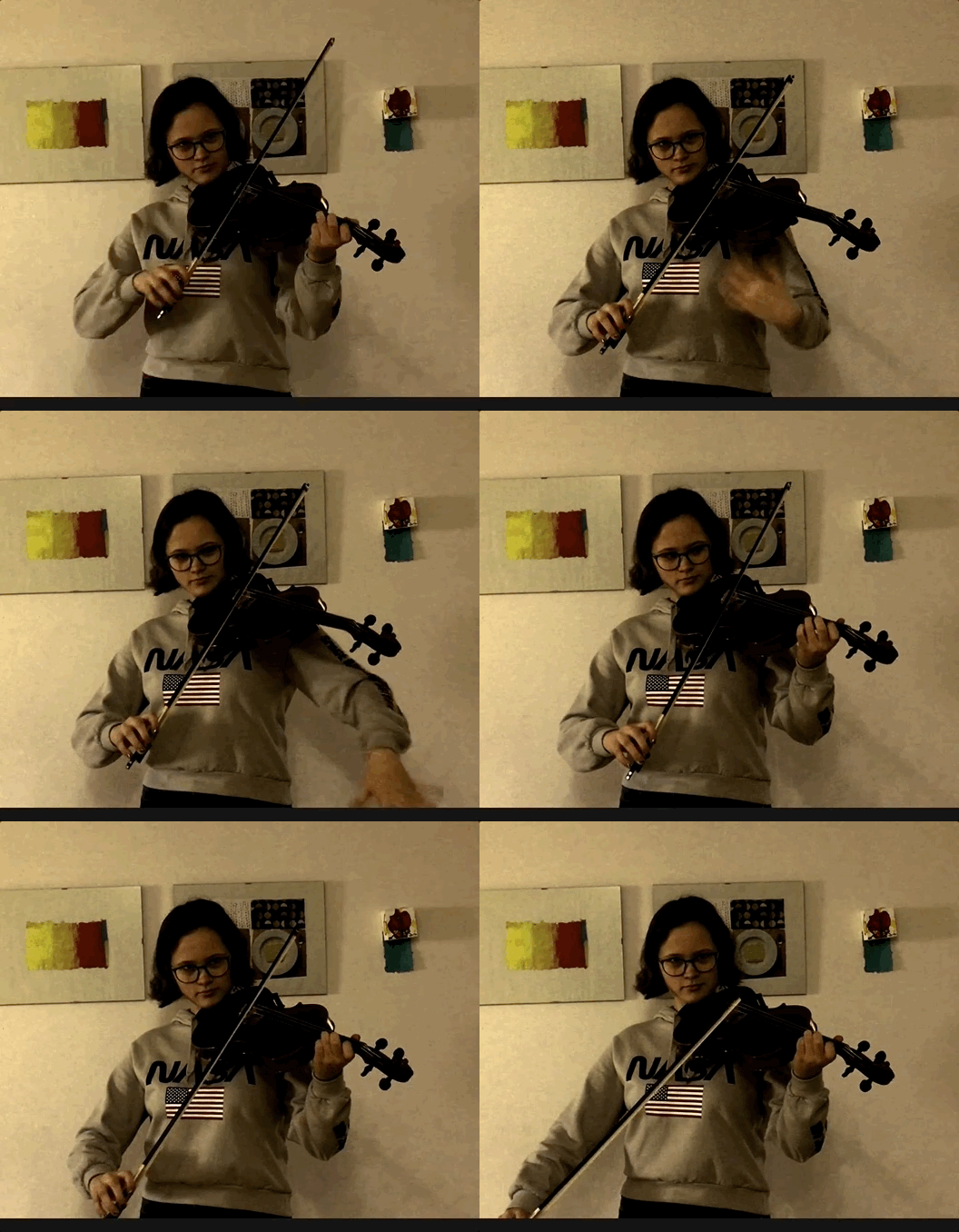
FRAGMENTS OF MODULES B2 AND B3 FOR VIOLA From Seven Deserts
PLAY MODULE B3 ONCE
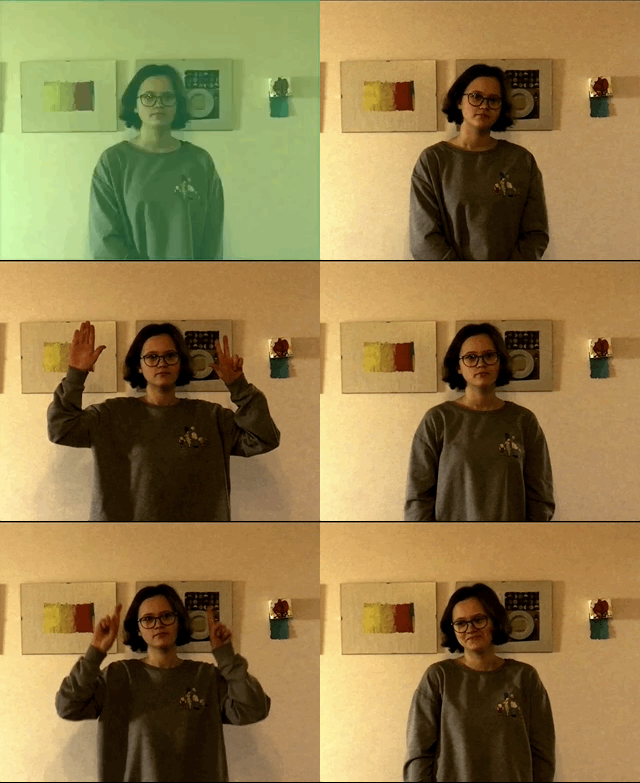
ON CUE, YOU PLAY B3 ONE TIME
A Five Corner Triangle CHEAT SHEET
How to Start a Module
Playing starts with a sequence of instruction signs from the conductor. It is natural human behavior to start searching your score immediately. Don’t! Stay focused on the conductor until he has finished his series of instructions. If the sequence involves more than one instruction, the conductor will repeat the sequence at least once. And anytime you don’t understand an instruction, just look mildly confused and shrug your shoulders. The conductor will repeat the sequence as many times as necessary. You can also ask your neighbors for help. When you are ready, nod your head to the conductor. He may count you in immediately but also may have instructions to give to other musicians.
When the time has come to play your part (possibly with others) the conductor will show a pulse in 1/4. It is possible that the conductor that will show a pulse that is faster than you feel comfortable playing. If so, shake your head “no” and show the conductor a more realistic tempo.
The conductor will then conduct an empty bar of 4/4, regardless of the time signature of the first bar. Play on the one of the second bar.
Because A Five Corner Triangle includes a variety of time signatures for modules that can be played simultaneously, it is often not possible for the conductor to show beats. For the sake of consistency, the conductor will show only pulse (beat time in 1/4), even in situations where only a single module has been triggered.
It is likely that the conductor will stop showing pulse and turn his focus to other matters. Continue playing. In performances of my other modular works, members of a group that have been assigned a module spontaneously start to nod on the one of each bar. That’s not such a bad idea.
As with all aspects of this piece, continue playing until you are cued to stop (more about that below).
For example, if the conductor wants you and two other musicians to play module Y4 twice, he will point to you and the others and show Y4, followed by R2 (“R” indicates the number of times to play a module). Then he will repeat the instruction. Nod yes when you are prepared to play.
When the time comes, he will show a pulse to you. If the pulse is too fast, show him an acceptable pulse. Then he will count you in.
PLAY MODULE Y4 TWO TIMES from Seven Deserts
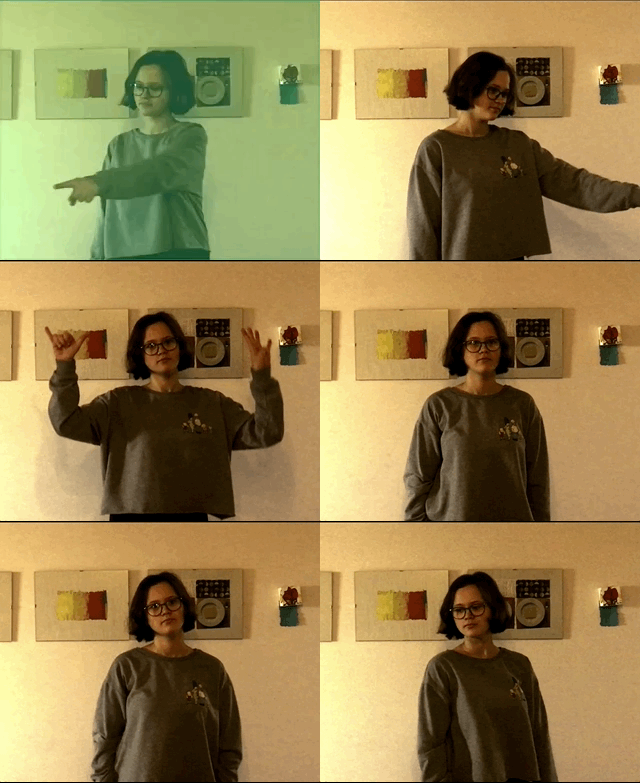
ON CUE, YOU TWO PLAY Y4 TWICE
SOLOING AND IMPROVISING
For the purpose of this piece, “solo” means contrast and “improvise” means blend.
The sign for “you solo” is U. The conductor will point to you and may also use pantomime to editorialize on your solo’s direction. Please try to make each of your solos different from your other solos.
The sign for “improvise” is I. The conductor may also indicate who you should blend with by cupping his ear and pointing to them.
Just as with a cue for a module, the cues for solo and improvise mean prepare to solo or improvise rather than start immediately. But unlike modules, solos and improvisations may or may not be counted in, depending on whether the conductor wants you to start in sync with other cues, such as stopping playing or starting a module. The conductor may count you in or just indicate that you should start.
Although the material in the modules is tonal and rhythmic, the nature of your solos and improvisations is up to you. You can, of course, refer to the modules, but don’t let them constrain you.
SIGNS FOR IMPROVISE AND SOLO
IMPROVISE WITH THEM
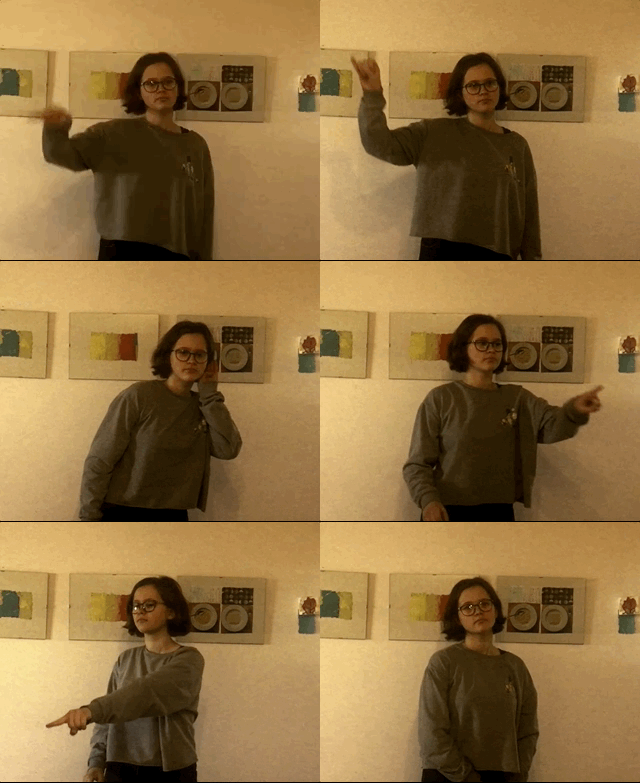
ON CUE, IMPROVISE AND LISTEN TO THESE THREE PEOPLE
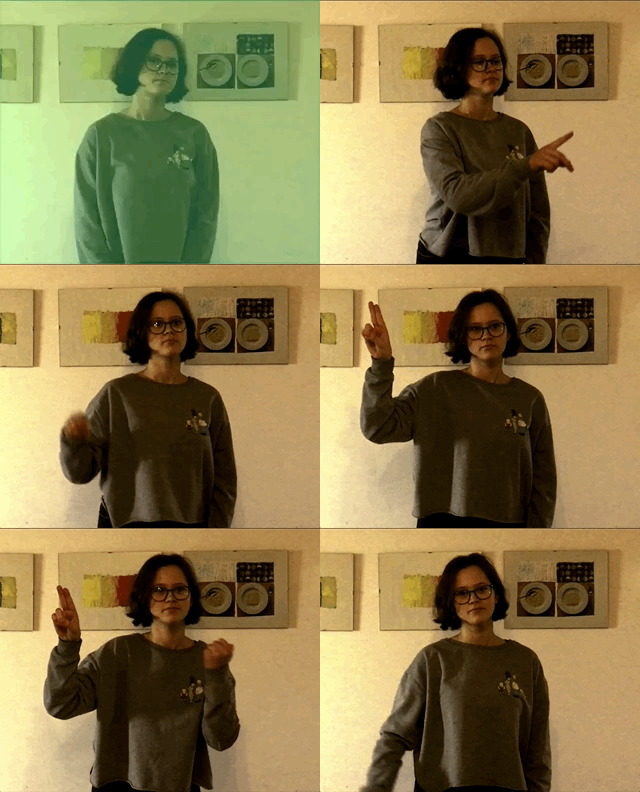
ON CUE, YOU TWO SOLO AND BE STRONG!
HOW TO STOP
If you are playing, whether modules, a solo, or improvisation, please continue until the conductor stops you.
If you want to stop, whether for musical reasons or because of fatigue, shake your hand as though it hurts and then continue playing. The conductor will soon cue you to prepare to stop.
The conductor will prepare you to stop by covering his mouth and pointing to you. Although it’s natural to become quieter when you see this gesture, please do the opposite. To encourage you to sustain your energy level, the conductor may rotate his free hand.
To stop you, the conductor may count you out or he may just pantomime for you to stop. If he counts you out, he will conduct a bar of 4/4. Stop on the second “one.”
I SHOULD STOP PLAYING SOON.
PREPARE TO STOP PLAYING (SUSTAIN ENERGY)
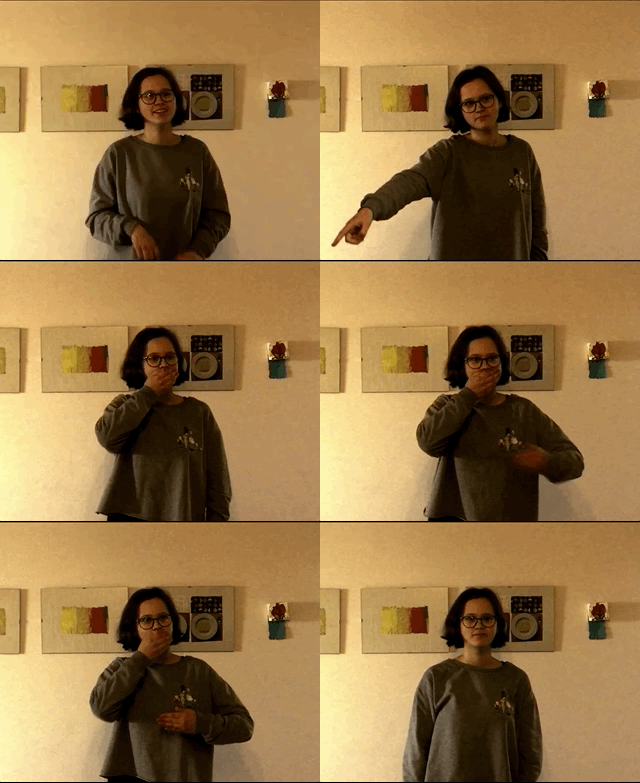
PREPARE TO STOP WHILE MAINTAINING YOUR LEVEL UNTIL THE CUE
negotiation
Interactivity between the performers and the conductor is an important component of my modular compositions. As the piece progresses, please think about how you would like to affect its direction. Suggestions that you make are passed to the conductor using the same hand signs and pantomime that he uses.
Say, for example, that your suggestion is that you play module B3 once with one of the flutists and the tubist. Point to yourself, then the other musicians, then show B3 followed by R1.
The most common suggestion is to ask to solo or improvise. That’s fine, of course. Just point to yourself and show a U or I. If you want to solo or improvise with others, point to them first.
You can suggest anything at all to the conductor. Just bear in mind that he has the option of accepting, modifying, or ignoring suggestions.
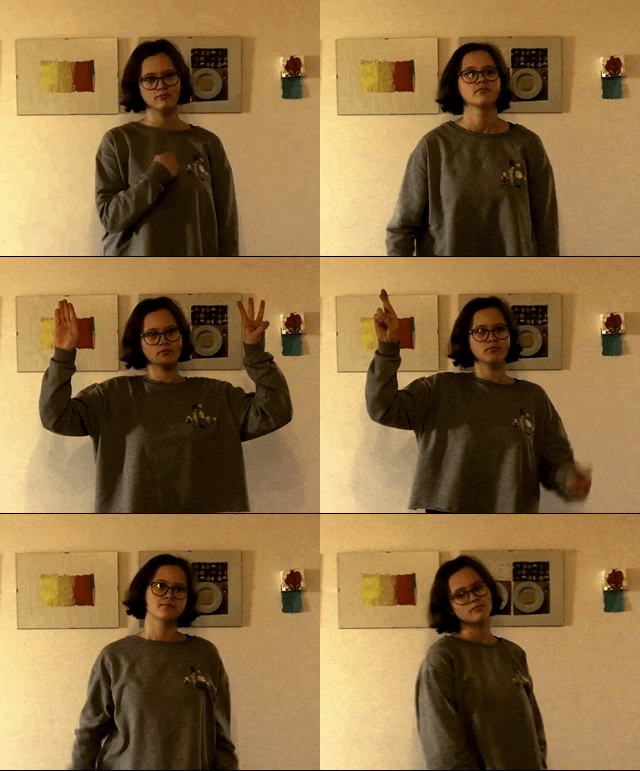
I SUGGEST THAT I PLAY B3 ONCE
playing techniques
A Five Corner Triangle’s parts do not include playing techniques. That’s up to you. Pizzicato, slap tongue, mutes, preparations, overblowing, harmonics, anything is fair game. Additionally, the conductor may pantomime techniques that he would like you to use. There is no specific set of signs for techniques; the conductor and you will have to Harpo-Marx it.
noise
Noise for our purposes is defined as sounds that obscure pitch to some extent. You have to decide exactly what that means, but noise does not refer to volume. There are times where substantial amounts of noise could be introduced into modules, improvisations, or solos. The sign for noise is a hand over each ear and mouth open, much like Edvard Munch’s The Scream (Skrik, Der Schrei der Natur).
INCLUDE NOISE

ON CUE, YOU FOUR INTRODUCE NOISE INTO YOUR PARTS
Mistakes
A Five Corner Triangle engenders mistakes. It isn’t possible to rehearse the infinite combinations of modules, instrumentation, and tempi. Most mistakes will not be obvious to the listener. The exception is modules in which you are playing rhythmic unison.
In all cases, the best approach is to cover the error rather than stopping. Say, for example, that you fall out of sync in a written section. Rather than stopping, try one of these strategies.
➤ Improvise a beautiful interlude and then rejoin the passage.
➤ Improvise but don’t rejoin the passage.
➤ Continue to play out of phase with the other musician or musicians.
Similarly, if you happen to miss a cue, cover the error musically. If, for just one example, you fail to stop when the conductor cues a stop. Instead of stopping a little late (the worst solution), you could continue on, playing louder than you had been. If you had been playing a module, you could continue that and then develop it into an improvisation.
EXTRA CREDIT READING
Scott Fields’ modular pieces
A Five Corner Triangle is a descendent of five other modular compositions Fields recorded for improvising chamber ensembles of varying sizes. They are 48 Motives (octet, Cadence Jazz Records 1997), 96 Gestures (12 musicians, New World Records/CRI 2001), OZZO (24 musicians, Clean Feed Records 2011), Seven Deserts (20 musicians, New World Records 2021), and Sand (20 musicians, Relative Pitch Records 2024).
Fields became interested in modular works as a reaction to the extreme micro-management of musical components by contemporary composers such as Milton Babbitt and Elliott Carter. With such complete control of the musical landscape, it became possible for a definitive version of a composition to be documented on recordings. This ability to capture the composer’s intentions contrasts with pre-20th-century works, which are interpreted broadly. Through modular composition Fields introduces broad variations of interpretation, even within a single evening’s performance. The modular works, all of which also integrate improvisation, also completely engage the performers, who can be called upon in a moment’s notice and who negotiate with the conductor through hand signals.
These compositions are constructed of a set of modules whose interrelationships vary predictably from strong to distant. In performance (including recorded performance) an improvising conductor working in the moment selects and layers modules in any order. The conductor uses the American Manual Alphabet as well as traditional conducting gestures to select modules (not all are played in any one performance, and they can be repeated and combined in any way), instrumentation, dynamics, tempi, and other musical attributes. The conductor also can direct the instrumentalists to improvise on the modules’ themes, pitch material, and rhythmic structures. Additionally, the performers use hand signals to makes suggestions to the conductor about which modules they would like to play and with whom, as well as other aspects of the performance. In that way each performance of a given composition is the result of a real-time negotiation between the conductor and the performers. Because of each piece’s tonal structures and motifs, each composition retains an identifiable characteristic although the performances can be radically different from each other.
The first of Fields’ modular pieces — 48 Motives — is the simplest in structure. The minimum ensemble size is a conductor plus eight instrumentalists: four players of what I’ll refer to as melodic instruments and two teams of a contrabassist and a percussionist. The composition consists of 96 modules. Each of the “melodic instruments” has 12 modules written for it, for a total of 48. The 12 modules for each melodic instrument are constructed on 12 scales — from a post-serial, pseudo-tonal pitch-selection system Stephen Dembski developed — that were closely related to each other but were not related to the scale sets for the other three instruments. Each of those modules has a complementary bass-percussion part, for another 48 modules. Each of the bass-percussion teams has 24 of these modules. And each of the melodic instrumentalists has 24: the 12 written for them and four each from the other three melodic instruments. That means that each of the melodic parts can be doubled, which is the strongest relationship. The next strongest relationship is a module based on the same scale set. All of the modules are 32 beats long.
The interrelationships in the second modular piece — 96 Gestures — is considerably richer. The minimum ensemble size is a conductor plus 12 instrumentalists: eight melodic instruments and again two teams of contrabassist and a percussionist. Again, each of the “melodic instruments” has 12 modules written for it, for a total of 96, and each of those players has 36 modules: 12 written for their instrument and four from each of the other seven, for a total of 40. That means that any part can be tripled, and likewise for the conductor to cue the same part for two or three players is still the strongest relationship. Like Motives, Stephen Dembski pitch-selection system provides four tonal centers. But unlike Motives, the modules in Gestures are written as 48 pairs that work together as counterpoint. So the next strongest relationship the conductor to cue is to have one to three instruments play a module that is a pair to the module that one to three other instruments are to play. That all means that the conductor can cue a unit of eight musicians (three playing one module, three playing its counterpoint mate, and two playing the complementary bass-percussion part) that has a very close relationship. And of course, he can exploit weaker relationships at will. Like Motives, the next strongest relationship is a module based on the same scale set. But Gestures has several additional relationship variables. In Gestures beat length varies from 28 to 56, in 12 increments. (Unlike Motives, in which all modules are 32 beats long.) And within the 12 beat groupings, half of the modules will use one time signature and half will use another. For example, for the 30-beat group, half are in 3/4 and half are in 5/4. So there are relationships beat lengths and time signatures that the conductor can exploit. Finally, each of the beat groups has a number of beats that can be multiplied or divided evenly by two, three, or four by one of the other beat groups. For example, the 45-beat group repeated twice (90 beats) equals the 30-beat group repeated three times (again 90 beats). This relationship allows for the sorts of phase relationships found in some Minimalist music.
The third modular piece — OZZO — is a simplified composition for a large ensemble with little rehearsal time. OZZO is constructed of 96 three-bar (in 5/4+5/4+1/4, so 33-beat) ostinatos. One fourth of the modules are rhythmic noises in three ranges. One fourth are half-noise/half-pitch. One fourth are long tones for constructing spontaneous harmonic structures. And the remaining fourth are angular melodies for constructing spontaneous counterpoint. Dembski’s pitch-selection system again provides four tonal centers. A new feature of OZZO is the use of sub-conductors, who are performers pulled from the orchestra as needed. The conductor can call on the sub-conductors to produce contrasting tempi.
The material in the fourth modular piece — Seven Deserts — is based on five pitch sets that repeat over two octaves. There are 20 modules, each of which is fragmented into five (each with four musicians assigned to it, in four-part harmony) submodules for a total of 100 (or 400, if you count the harmonization). Each musician has 20 of these units.
The first five submodules are repetitive patterns, or “pulse tracks.” The second five submodules are short melodies, or “motives.” The third five submodules or “gestures” are short melodies that are paired with the “motives.” The final five submodules are long tones. The modulus and submodules vary in 20-percent increments from dense (100 percent of beats covered) to sparse (20 percent covered).